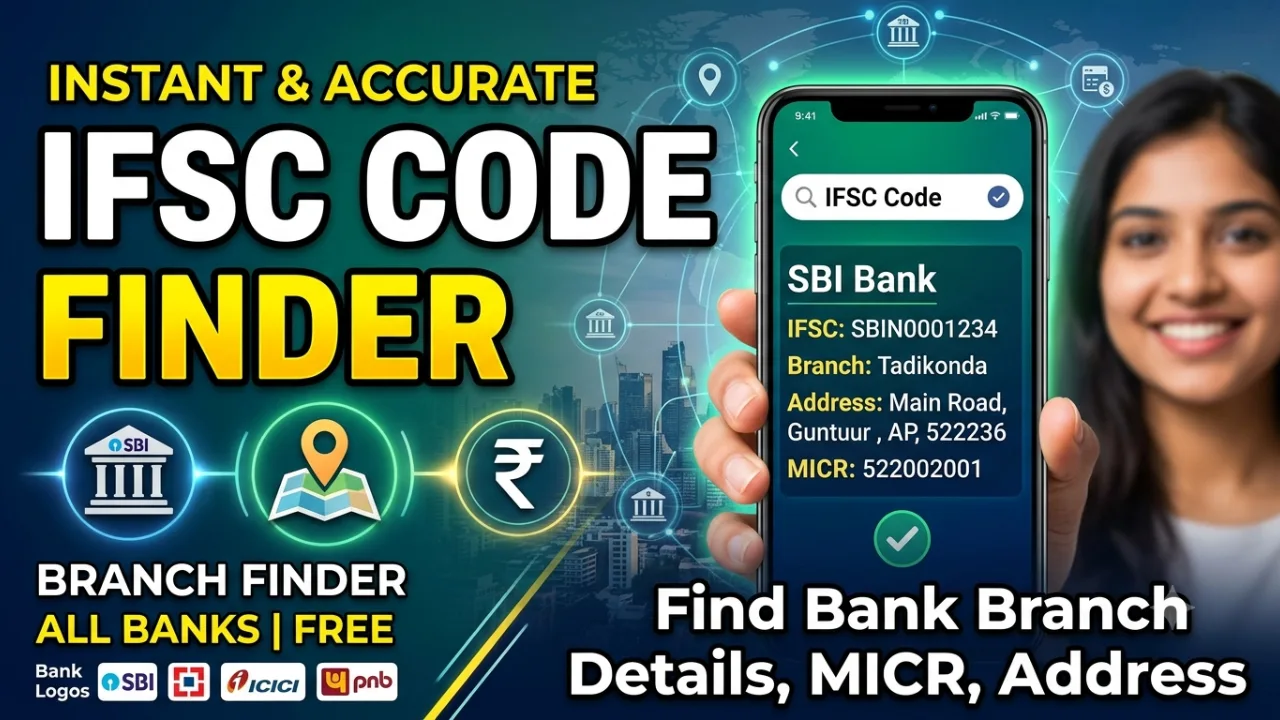
Find IFSC Code Details
Enter an Indian bank IFSC code to find bank, branch, address, MICR, contact and other available banking details.
Recent IFSC Codes
This tool provides banking information for reference. Always verify important details with your bank before making a transaction.
IFSC Code Finder: Find Bank Branch Details, MICR, Address and Banking Information Online
Finding the correct bank branch information is an important part of making online payments, transferring money, filling out banking forms, verifying an account, and checking financial details. One of the most commonly required banking identifiers in India is the IFSC code.
An IFSC code helps identify a particular bank branch for electronic fund transfers in India. Whether you are sending money through NEFT, RTGS, IMPS, or using another banking service, you may need the correct IFSC code of the receiving branch.
Our IFSC Code Finder is designed to make this process easier. Instead of manually searching through multiple banking websites or long lists of branches, you can enter an IFSC code and quickly find the available bank and branch information associated with it.
The tool is designed with a simple, mobile-friendly interface, making it convenient to use from smartphones, tablets, laptops, and desktop computers.
You can use the tool to check details such as the bank name, branch name, IFSC code, address, city, district, state, bank code, MICR code, contact information, geographical coordinates, and other information when available from the data source.
What Is an IFSC Code?
IFSC stands for Indian Financial System Code.
An IFSC code is an alphanumeric code used to identify a specific bank branch participating in electronic fund transfer systems in India.
A standard Indian IFSC code contains 11 characters.
For example:
SBIN0001234
The structure of an IFSC code generally contains a four-character bank identifier, followed by the character 0, and then a six-character branch identifier.
The exact code depends on the bank and branch.
Because every branch has its own IFSC code, entering the correct code is important when initiating certain electronic bank transfers.
Why Is an IFSC Code Important?
The banking system includes thousands of branches across India. A bank may have hundreds or thousands of branches, so simply knowing the bank name is not enough to identify a specific branch.
The IFSC code provides a standardized way to identify the destination branch for supported electronic fund transfer processes.
You may be asked for an IFSC code when:
- Sending money to another bank account
- Adding a bank beneficiary
- Making an NEFT transfer
- Making an RTGS transfer
- Completing some IMPS-related transactions
- Filling out banking forms
- Adding bank details to a payment platform
- Verifying branch information
- Checking a recipient’s banking details
A mistake in the IFSC code can result in transaction issues, so it is always important to verify the code before completing a transfer.
What Is the IFSC Code Finder?
The IFSC Code Finder is an online tool that helps you find and verify bank branch information using an IFSC code.
Instead of searching through a bank’s website or browsing large branch lists, you can simply enter the 11-character IFSC code and retrieve the available information associated with that code.
The tool is designed to make IFSC lookup faster and easier for everyday users.
Depending on the available data, the result can include:
- IFSC code
- Bank name
- Branch name
- Bank code
- Bank type
- Branch address
- City
- District
- State
- Contact information
- MICR code
- SWIFT or BIC information where available
- IIN where available
- Latitude and longitude where available
- Banking service information where available
- Google Maps location
The exact fields can vary depending on the bank and the available data source.
How to Use the IFSC Code Finder
Using the tool is simple.
Step 1: Open the IFSC Code Finder
Open the IFSC Code Finder on Rolol.com from your browser.
You do not need to install a separate application.
Step 2: Enter the IFSC Code
Type the 11-character IFSC code into the search box.
For example:
HDFC0001234
The tool automatically converts lowercase letters to uppercase and removes unnecessary spaces.
Step 3: Click Find Bank Details
Press the Find Bank Details button.
The tool sends the search request to the available IFSC data service.
Step 4: Review the Result
If the code is valid and information is available, the tool displays the bank and branch details in an easy-to-read format.
Step 5: Copy or Share
You can copy important information such as the IFSC code, MICR code, or branch address.
The share option can also help you send the result to another person.
Step 6: View the Location
When geographical coordinates are available, the map option can help you open the branch location in Google Maps.
What Information Can You Get From an IFSC Code?
An IFSC code can help identify a specific banking branch.
Our IFSC lookup tool organizes the available information into simple sections so users can find important details quickly.
Bank Name
The result can display the name of the bank associated with the IFSC code.
This is useful when you have received an IFSC code but are not sure which bank it belongs to.
Branch Name
The tool can display the branch name associated with the code.
A single bank can have many branches in the same city or state, so branch-level information can be useful for verification.
IFSC Code
The searched code is prominently displayed so you can quickly verify that the result matches the code you entered.
Bank Code
The bank code is part of the IFSC structure and helps identify the institution.
Bank Type
Where the data source provides the information, the tool can display the type of bank or banking institution.
Branch Address
The complete branch address is one of the most useful pieces of information available through an IFSC lookup.
It can help you confirm whether the branch corresponds to the location you expected.
City
The result may show the city in which the branch is located.
District
The district can provide additional geographical information, especially when multiple places have similar names.
State
The state helps confirm the broader location of the bank branch.
Contact Information
Where branch contact details are available in the data source, the tool can display them for reference.
MICR Code
A MICR code is another banking identifier used in India.
If MICR information is available in the underlying dataset, the tool displays it in the banking codes section.
SWIFT or BIC
SWIFT/BIC identifiers are generally associated with international banking and transfers.
Not every Indian bank branch will have a branch-specific SWIFT code. Therefore, the tool only shows this information when it is actually available from the source.
IIN
IIN can also appear in some banking datasets when the relevant information is available.
Latitude and Longitude
Some datasets include geographical coordinates.
When coordinates are available, the tool can provide a map option so users can view the location.
What Is the Structure of an IFSC Code?
An IFSC code contains 11 characters.
Using a sample structure such as:
ABCD0123456
The first four letters identify the bank.
The fifth character is 0.
The remaining six characters identify the branch.
The actual characters vary according to the bank and branch.
This structure makes IFSC codes useful for identifying a particular branch within the Indian banking network.
IFSC Code Examples
Here are fictional examples used only to demonstrate the format:
ABCD0123456
WXYZ0009876
TEST0A12345
Never use fictional examples for an actual money transfer. Always obtain the correct IFSC code for the specific destination account and bank branch.
IFSC Code vs MICR Code
IFSC and MICR are both banking identifiers, but they serve different purposes.
IFSC
IFSC stands for Indian Financial System Code.
It is primarily associated with identifying bank branches for electronic fund transfer systems.
MICR
MICR stands for Magnetic Ink Character Recognition.
MICR is associated with cheque processing and other banking identification processes.
Because both codes may appear in banking forms, users sometimes confuse them.
An IFSC lookup tool can make it easier to see both codes together when the available data includes MICR information.
IFSC Code vs SWIFT Code
IFSC is primarily used in India’s domestic banking and electronic fund transfer environment.
SWIFT/BIC is used for identifying financial institutions in international banking transactions.
They are not interchangeable.
When making a domestic transfer within India, you may be asked for an IFSC code.
For international transfers, the bank may ask for a SWIFT/BIC code along with other information.
Always follow the requirements of your bank and the receiving institution.
When Do You Need an IFSC Code?
There are many situations where you may need an IFSC code.
Sending Money
When transferring money to a bank account, the receiving branch’s IFSC may be required depending on the transfer method and bank.
Adding a Beneficiary
Online banking systems may request the beneficiary’s bank and branch information.
NEFT Transactions
IFSC codes are commonly used to identify destination bank branches for NEFT transactions.
RTGS Transactions
IFSC can also be relevant for RTGS payments.
Bank Account Verification
Businesses and individuals may use an IFSC lookup to verify branch information.
Forms and Applications
Some forms require banking information such as the account number, bank name, branch and IFSC code.
Salary and Payment Information
Employers may collect bank information from employees for salary payments.
Business Payments
Companies often use bank details when making vendor, customer, or supplier payments.
How Does an IFSC Lookup Work?
The basic process is simple.
First, the user enters an IFSC code.
The tool validates the format.
The application then requests information from a postal or banking data source.
The returned record is processed and displayed in a structured format.
Instead of presenting a long block of technical information, the tool groups related information into sections such as:
Bank & Branch Details
Branch Location
Banking Codes
Banking Services
This makes it easier to find the exact information you need.
Why Is Format Validation Useful?
A standard IFSC code contains 11 characters.
The tool checks the basic pattern before making a lookup request.
This helps prevent unnecessary API requests caused by obvious typing mistakes.
For example, if the user enters fewer than 11 valid characters or uses an invalid structure, the tool can display an error message instead of performing a lookup.
This makes the search experience faster and more efficient.
Can You Find a Bank Name Using an IFSC Code?
Yes.
One of the simplest uses of an IFSC lookup tool is identifying which bank is associated with a code.
This is particularly useful when someone sends you an IFSC code separately from the bank name.
The tool can return the bank name along with branch information when the source contains the relevant record.
Can You Find a Branch Address Using an IFSC Code?
Yes, where address information is available.
After entering an IFSC code, the result may include the branch’s full address, city, district, and state.
This can help you verify whether the IFSC code belongs to the branch you expected.
Can You Find MICR From an IFSC Code?
A banking database may contain both IFSC and MICR information.
When the selected data source provides a MICR value, the tool can display it.
However, not every record necessarily contains every banking identifier, so unavailable data should not be treated as missing due to an error in the tool.
Can You Find the Branch Phone Number?
Some bank branch datasets contain contact information.
When contact information is provided by the source, the tool can display it.
Bank contact numbers can change, however, so for important matters it is always advisable to confirm the current contact details with the bank.
Can You Find the Bank Branch on Google Maps?
When latitude and longitude data are included in the result, the tool provides an option to open the coordinates using Google Maps.
This can be useful if you want to understand the branch’s physical location.
Keep in mind that coordinates and map information are dependent on the available source data.
Is the IFSC Code the Same for Every Branch of a Bank?
No.
A bank can have many branches, and different branches can have different IFSC codes.
The code is intended to identify the relevant bank branch for the applicable banking process.
This is why you should always use the IFSC associated with the recipient’s actual account and branch information.
What Happens If an IFSC Code Changes?
Banks can sometimes reorganize, merge, relocate, or close branches.
As a result, banking identifiers may change over time.
An old IFSC code might become inactive or be replaced by another code after a bank restructuring or branch change.
For this reason, users should verify important banking information before making transactions, particularly when using an old beneficiary record.
What If My IFSC Code Is Not Found?
There are several reasons a lookup may not return a result.
The code may have been entered incorrectly.
The selected code may no longer be active.
The branch may have changed after a merger or reorganization.
The data source may not contain the latest information.
There may also be a temporary technical issue with the lookup service.
Start by checking all 11 characters carefully.
If the information is important for a financial transaction, confirm the code directly with the bank.
Is an IFSC Lookup Safe?
A basic IFSC lookup only requires the IFSC code.
You should never enter sensitive banking credentials such as:
- Internet banking passwords
- ATM PINs
- UPI PINs
- OTPs
- Debit card PINs
- Full account login credentials
An IFSC code is a bank branch identifier, not a password.
The IFSC Finder should be used for public branch information rather than confidential financial credentials.
Can an IFSC Code Reveal a Bank Account Number?
No.
An IFSC code identifies a bank and branch. It does not reveal your private bank account number.
The account number is separate and should be treated as private financial information.
Likewise, an IFSC code by itself does not provide access to a person’s bank account.
Why Businesses Use IFSC Lookup Tools
Businesses often work with large amounts of banking information.
For example, a company may need to process payments for employees, vendors, suppliers, contractors, or customers.
An IFSC lookup tool can help employees quickly verify branch information without manually searching through individual bank websites.
This can make routine administrative tasks easier.
Why Freelancers and Professionals May Need IFSC Information
Freelancers and independent professionals regularly receive payments from clients.
When providing bank details to a client, they may need to share the correct IFSC code together with the account information.
A quick lookup tool can help verify the branch details before sending banking information.
IFSC Lookup for Salary Accounts
Companies may collect employee bank details for salary processing.
In some cases, employees need to provide:
- Account holder name
- Account number
- Bank name
- Branch
- IFSC code
Using a lookup tool can help employees verify the bank and branch associated with their IFSC code before submitting the information.
IFSC Lookup for Online Forms
Various applications may ask users to enter bank information.
Before submitting the form, it can be useful to confirm that the IFSC code corresponds to the correct bank branch.
This simple verification step can reduce avoidable data-entry mistakes.
Mobile-Friendly IFSC Search
Modern users often search for banking information on their smartphones.
The IFSC Finder is designed with a mobile-app-style interface that includes:
- Large touch-friendly controls
- Clear banking cards
- Responsive layouts
- Simple search interaction
- Bottom navigation
- Fast copy buttons
- Share functionality
- Map access
The interface adapts to smaller screens so the result remains easy to read.
Copy IFSC in One Tap
Manually selecting an IFSC code can be inconvenient on a smartphone.
The Copy button provides a quick way to copy the code to your clipboard.
You can then paste it into:
- Banking applications
- Forms
- Messages
- Emails
- Spreadsheets
- Documents
This reduces manual typing.
Copy MICR and Address
The tool can also make it convenient to copy other available information.
For example, you can copy the MICR code or the branch address without having to select the text manually.
This can be especially useful when completing forms on mobile devices.
Share Bank Branch Details
The Share option is useful when another person needs the same bank branch information.
Depending on the device and browser, you can use the native share functionality to send the details through compatible applications.
The shared information can include the bank, branch, IFSC code, city, and state.
Recent IFSC Searches
The tool can remember recent IFSC searches locally in the browser.
This is useful if you are repeatedly checking the same branch or working with multiple bank records.
Instead of retyping the same code, you can select it from the recent search list.
Why Accurate Banking Information Matters
Banking transactions involve real money, so accuracy is important.
Before making a transfer, verify the:
- Beneficiary name
- Account number
- IFSC code
- Bank name
- Transfer amount
Do not rely on an old saved banking record without checking whether the information is still valid.
Important Banking Safety Tips
Never share your UPI PIN, OTP, card PIN, internet banking password, or other confidential credentials with anyone.
Banks and legitimate payment providers do not require you to reveal your secret authentication information to complete an ordinary IFSC lookup.
Before transferring money to a new beneficiary, verify the account details carefully.
For large or sensitive transactions, confirm the information through your bank.
What does IFSC stand for?
IFSC stands for Indian Financial System Code.
How many characters are in an IFSC code?
A standard IFSC code contains 11 characters.
Can I find the bank using an IFSC code?
Yes. An IFSC lookup can identify the bank associated with the code when the code exists in the data source.
Can I find the branch using an IFSC code?
Yes. The branch name and other location details may be returned when they are available.
Can I find the address of a bank branch from its IFSC code?
Yes. Branch address information can be displayed when the database provides it.
Can I find MICR using an IFSC code?
Sometimes. If the underlying banking dataset contains a MICR code, it can be displayed along with the IFSC information.
Can I find a SWIFT code using an IFSC code?
Not necessarily. SWIFT/BIC and IFSC are different identifiers. A SWIFT code is only displayed when relevant information is available from the data source.
Is an IFSC code required for every bank transfer?
Not necessarily. The exact information required depends on the payment method, bank, and transaction type.
Can two branches have the same IFSC code?
The purpose of an IFSC is to identify a specific participating bank branch, so branch-specific codes are generally distinct. However, bank mergers, branch changes, and other events can affect banking identifiers.
Can an IFSC code expire?
Banking identifiers can become inactive or change due to branch closures, mergers, restructuring, or other changes. Always verify current information before an important transaction.
Is IFSC the same as a bank account number?
No. IFSC identifies the bank branch, while the bank account number identifies the specific account.
Can I search an IFSC code from my phone?
Yes. The IFSC Code Finder is designed to work on mobile phones and modern web browsers.
Do I need an app to use the IFSC Finder?
No. You can use the web-based tool directly from your browser.
Can I copy the IFSC code?
Yes. The tool includes a convenient Copy IFSC option.
Can I share the result?
Yes. The tool provides a Share option on supported devices and browsers.
Can I see the branch on a map?
When location coordinates are available, you can use the map option to view the location in Google Maps.
Is the information always guaranteed to be current?
No. Banking information can change, and third-party data sources may have different update schedules. For important transactions, verify the current details with the relevant bank.
An IFSC code may look like a simple combination of letters and numbers, but it plays an important role in identifying bank branches for electronic banking processes in India.
When you have an IFSC code and need to know which bank or branch it belongs to, manually searching through banking websites can be inconvenient.
The IFSC Code Finder provides a faster way to check available branch information from one place.
You can enter an 11-character IFSC code and, depending on the available banking data, view details such as the bank name, branch name, address, city, district, state, bank code, MICR code, contact information, geographical coordinates, and additional banking information.
The tool is particularly useful for students, employees, freelancers, businesses, online sellers, accountants, finance teams, and everyday users who need to verify bank information.
Its mobile-friendly design also makes it convenient when you are working from a smartphone.
At the same time, an IFSC lookup tool should be treated as a reference and verification aid rather than a replacement for your bank’s official information.
Before completing an important financial transaction, always confirm the beneficiary’s banking information, especially when the transaction involves a large amount of money.
Use the IFSC Code Finder on Rolol.com whenever you need a quick and convenient way to check an Indian bank’s branch information using an IFSC code.
⭐ Pincode Finder Tool